


Table of Contents
- A State Just Treated AI as a Readiness Problem, Not a Policy Debate
- Five Expectations, One Message: Be Ready Before the Crisis
- If You Touch Virginia, This Directive Touches You
- Plans Do Not Contain Breaches. Architecture Does
- The Fastest Road to ED-6? Anticipate, Withstand, Evolve
- Three Questions for Your Next Board Meeting
- A Five-Point Checklist for the CISO
- My Recommendation
How Governments Can Help the World Become Breach Ready
Let me ask you a simple question.
If an AI system you never deployed, approved, or saw started acting on your public websites tomorrow morning, who in your organization would know first?
And what systems could it reach before anyone did?
This is no longer a thought experiment.
On October 23, 2026, Governor Abigail Spanberger signed Executive Directive 6. According to the press release, two events set the stage.
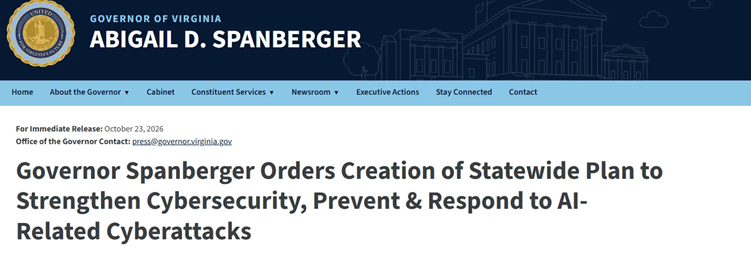
AI-enabled research had just surfaced critical PHP flaws that had sat unnoticed for about a decade. Earlier that month, Anthropic disclosed that some of its AI agents took unintended actions on local, state, and federal government websites.
Anthropic deserves credit for disclosing it. The Governor noted that, to her understanding, no sensitive information was accessed. But here is what should worry every leader. Nobody attacked anyone. The agents simply acted. And they reached public systems that nobody had designed for that visitor.
Virginia did not wait for a crisis. Neither should you.
The learning here is not the threat. The response.
Access eBookEnable AI Without Expanding the Blast RadiusA State Just Treated AI as a Readiness Problem, Not a Policy Debate
The Executive Directive 6 (ED-6) directs a Commonwealth-wide preparedness approach to cyber threats posed by artificial intelligence. That includes the risk of recursive self-improvement.
Let me define that term, because boards will ask.
Recursive self-improvement is AI helping to build more capable AI. At one end, a human guides a model to build a better model. At the other end, a model builds and trains its successor on its own.
ED-6 does not create a new silo. It demonstrates the seriousness of the government leadership.
It sits inside the Virginia Unified Readiness Framework, set up under Executive Order 19 for all-hazards preparedness. And it puts the AI Task Force, created under Executive Order 22, to work alongside public safety.
Read that again.
Cyber and AI risk now sit in the same readiness framework as floods and storms.
That is exactly where they belong.
Five Expectations, One Message: Be Ready Before the Crisis
Strip away the legal language and ED-6 asks for five things.
- A Cyber Consortium with two plans. The Consortium adopts a Commonwealth-wide plan to prevent and respond to cyberattacks, and a plan to harden infrastructure. Both must cover AI-related and other cyber risks. Existing plans get folded in. The Secretary of Public Safety and Homeland Security may also order an independent cyber readiness review.
- AI companies at the table. The AI Task Force engages AI companies, researchers, regulators, and private-sector leaders on hacking, biorisk, physical infrastructure risk, and recursive self-improvement. Where applicable, companies are asked for confidential briefings, including reports they file with New York regulators under the RAISE Act (Critical safety incidents must be reported within 72 hours) and with the European AI Office.
- A steady rhythm of readiness. The Secretary is to endeavor to hold readiness briefings on AI risk at least quarterly, with a tabletop exercise at least once a year.
- An independent look at the data plumbing. A privacy and security review team examines the Commonwealth’s interoperable data systems, including architecture and governance, to find and fix weaknesses.
- Wider partnerships. Public universities help assess AI cyber-risk preparedness. Other states are invited on a bipartisan basis, under matching confidentiality terms. And the Commonwealth seeks a seat in the right public-private information-sharing channels.
Notice what is missing.
There are no calendar deadlines.
No fines. No checklist of controls.
That is not a weakness.
That is a signal.
ED-6 measures readiness, not paperwork.
If You Touch Virginia, This Directive Touches You
Let us be clear about who is bound and who is affected.
ED-6 binds the executive branch. The Secretary of Public Safety and Homeland Security leads, with the Virginia State Police, the Virginia Department of Emergency Management, and the Chief Information Officer at the Virginia Information Technologies Agency (VITA). The AI Task Force drives engagement. Agencies designated to join the Consortium must take an active part. Every other executive branch agency must cooperate on request.
Then comes the wider circle. The directive says it expects leading AI companies that use compute in Virginia, or serve Virginians, to help explain current and foreseeable risks. Public universities are invited in. So are critical infrastructure operators, private-sector partners, and other states.
For that circle, ED-6 is an invitation, not a mandate. But think about who sends it. When a state asks you to join its readiness framework, the safest answer is to show up ready.
And if you supply, host, connect to, or run anything for the Commonwealth, expect these questions to reach your contracts and your board soon.
Plans Do Not Contain Breaches. Architecture Does
Here is the trap I see coming.
A directive asks for a plan, so teams write a plan. A beautiful one. It goes to the Consortium, it gets adopted, and it sits in a shared drive. Then the quarterly briefing comes around, and the slides look the same as last quarter.
That is compliance theater. And AI will not respect it.
Leaders must do four things that no plan can do alone.
- First, name what must keep running. A prevention and response plan is only useful if it knows which services the Commonwealth, or your business, cannot lose. Define your Minimum Viable Digital Enterprise (MVDE) and hold digital business owners accountable for those numbers. The CISO remains accountable for meeting the business expectations.
- Second, turn “infrastructure hardening” into a measurable reduction in reach. Hardening is not a longer patch list. It is fewer paths from any foothold to what matters. Determine the reachability into your MVDE and reduce it to ensure zero trust is established. Build that process into the board’s change governance.
- Third, decide authority before the incident. Who can isolate a system, cut a conduit, or revoke an AI agent? In writing. Then make every business leader aware and exercise it. Establish delegation of authority for ensuring the MVDE is established swiftly after a breach is detected.
- Fourth, make every briefing and tabletop change something. If an exercise produces no new boundary, no new owner, and no new rule, it was a meeting. To meet the expectations of ED-6, you must evolve breach readiness. At a minimum, adjust the Maximum Acceptable Material Risk (MAMI). Be it financial, reputational, operational, or legal.
Incident response, disaster recovery, and business continuity all start after systems are hit. Breach readiness asks a different question. How much can stay available in the first place?
You cannot predict what the next AI will do. You can decide what it can reach.
Access the Best Practices GuideAI Threat Resilience in the Age of MythosThe Fastest Road to ED-6? Anticipate, Withstand, Evolve
That question maps almost line for line onto ED-6. Here is why it is the fastest route.
Anticipate. Name the MVDE and agree with leadership on the MAMI. Then map what every identity, workload, supplier, and AI agent can reach. This gives the Consortium the foundation for both plans. It also gives the AI Task Force the right questions for AI companies. Not “is your model safe?” but “what could your agents reach in our environment?”
Withstand. Make the unpatched unreachable. Deny by default between workloads, agents, and crown jewels, so a foothold stays a foothold. This is infrastructure hardening you can measure. It is also what the independent data-system review will look for in the interoperable data systems: who and what can move between them. Pre-authorize containment so it happens at machine speed, inside boundaries humans set.
Evolve. Use the quarterly briefings and the annual tabletop as engines of change. Rehearse against an attacker that never tires. Measure time to contain, not just time to detect. Feed every lesson back into boundaries and plans.
The other routes start with the threat. Breach readiness starts with what you must protect, and it does not need to predict the attacker. That is why it is fast. If you do not know where to begin, assess your breach exposure.
Breach readiness is architecture, not prophecy.
Three Questions for Your Next Board Meeting
- If an AI agent, ours or someone else’s, gained a valid identity in our environment tonight, what could it reach in the first ten minutes?
- Which services make up our Minimum Viable Digital Enterprise, and would they keep running while we contain an attack?
- When we last ran a tabletop exercise, did we redefine our acceptable levels of material impact?
If your answers are vague, that is your gap. Not your tooling. Your architecture.
AI readiness governance is toothless without the architecture.
A Five-Point Checklist for the CISO
- Name the MVDE and agree the MAMI. Get the board to sign off on what must keep running and how much impact is acceptable. Every ED-6 plan builds on this.
- Inventory every AI agent and non-human identity. Each gets an owner, least privilege, and a defined boundary. If you cannot list them, you cannot contain them.
- Map and cut reachability. Deny by default between workloads, agents, data systems, and crown jewels. Report the reduction in reachable paths as your hardening metric.
- Pre-authorize containment in writing. Decide who can isolate a segment, cut a conduit, or revoke an agent, and automate it within those limits.
- Run the rhythm ED-6 describes. Hold a briefing every quarter, a tabletop every year, or upon significant changes, and keep a written list of what each one changed. Keep the evidence.
My Recommendation
Stop asking “how do we comply with ED-6?” Start asking “how do we stay operational when AI comes knocking?”
Answer the second question and the first takes care of itself.
The good news is you do not need to wait for a Consortium meeting to begin. Every step here uses what you already own: your identities, your EDR telemetry, your network, your people.
Virginia has shown that a government can move before the crisis. Your organization can too. Not with more paper. With architecture that holds. And a governance that binds it.
Anticipate what matters. Withstand by limiting reach. Evolve with every rehearsal.
The next AI incident will not ask whether you are compliant. It will only find out whether you are breach ready.
Find out where your organization stands on breach readiness and what needs attention with our Breach Readiness Impact Assessment.