



The Internet of Medical Things (IoMT) has transformed healthcare by integrating sophisticated technologies into everyday clinical practices. IoMT devices—including connected infusion pumps, patient monitors, and imaging systems—play a crucial role in enhancing patient care and operational efficiency. However, the proliferation of these connected devices has introduced significant security challenges that traditional methods often fail to address. Among the various security strategies, microsegmentation has emerged as a highly effective approach for managing the complexities and risks associated with IoMT devices.
The Proliferation of IoMT Devices
“Historically, medical device manufacturers were reluctant to upgrade system software because doing so triggered expensive safety and performance review clearance processes,” says Lynne Dunbrack, IDC group vice president for the public sector.
The healthcare industry is witnessing unprecedented growth in IoMT devices. These devices collect and transmit critical patient data, support clinical workflows, and enable real-time monitoring. Despite their benefits, they also represent an expanded attack surface for cyber threats. Increased connectivity heightens the risk of cyberattacks, which can result in severe consequences such as data breaches, operational disruptions, and compromised patient safety.
Prevalent Challenges of IoMT Devices
- Legacy Devices: Many IoMT devices are outdated systems that were designed before modern cybersecurity practices were established. These devices often operate with outdated operating systems and firmware, making them vulnerable to known exploits. Upgrading or replacing these devices can be both costly and disruptive, leading to persistent security gaps.
- Patch Management Difficulties: IoMT devices are frequently used in critical healthcare environments where uptime is essential. Applying patches or updates to these devices can disrupt patient care or affect the functionality of interconnected systems, leading many devices to remain unpatched and exposed to vulnerabilities.
- Diverse Ecosystem: The IoMT ecosystem includes a broad array of devices from various manufacturers, each with different protocols, interfaces, and security practices. This diversity leads to inconsistencies in security implementations, making it challenging to enforce uniform protection measures. Attackers can exploit these inconsistencies to gain unauthorized access.
- Connectivity and Integration: IoMT devices are designed to connect and communicate with other systems such as electronic health records (EHRs), hospital networks, and cloud services. This extensive connectivity increases the attack surface, providing multiple entry points for cybercriminals. Once inside the network, attackers can move laterally to access other critical systems and data.
- Insecure Communication Protocols: Some IoMT devices use outdated or insecure communication protocols, making it possible for attackers to intercept or manipulate data. For example, if a device transmits sensitive health information over unencrypted channels, attackers could eavesdrop on or alter the data, compromising patient privacy and data integrity.
- Human Error: User and operational errors, such as configuration mistakes or inadequate training, can also contribute to the security vulnerabilities of IoMT devices. Default passwords or poor configuration practices may inadvertently expose devices to cyber threats, and healthcare staff might introduce risks by connecting insecure devices to the network.
- Interdependencies and Supply Chain Risks: IoMT devices often operate within a complex ecosystem of software and hardware components from various vendors. This interdependence creates opportunities for supply chain attacks, where vulnerabilities in one component or vendor’s product can compromise the entire system.
- Maintaining Patient Care During a Cyberattack: In the event of a cyberattack, maintaining uninterrupted patient care is crucial. Healthcare facilities must balance the need to secure their networks with the necessity of ensuring that medical devices continue to function reliably. Traditional security measures that disrupt device operations or lead to network-wide outages are unsuitable for environments where patient care cannot be compromised.
Why Microsegmentation is the Solution
The White House Office of Management and Budget has directed most federal civilian agencies to implement some level of zero-trust architecture by the end of fiscal 2024. For more information, read our blog on this topic: “Enhancing Cybersecurity in Healthcare with Microsegmentation: A Guide to Federal Funding Compliance”
Here’s why microsegmentation is particularly effective for securing IoMT devices:
- Enhanced Visibility and Granular Control: Microsegmentation provides detailed visibility into network traffic, enabling healthcare IT teams to monitor and control communications between IoMT devices and other network components. By segmenting the network based on device types and functions, organizations can implement tailored security policies for each segment. This approach ensures that even if a legacy device or unpatched system is compromised, the threat is contained within its segment.
- Containment of Threats: One of the most significant advantages of microsegmentation is its ability to contain threats. In the event of a breach, microsegmentation limits the attacker’s movement, preventing them from spreading to other parts of the network. This containment is critical in environments where IoMT devices operate alongside essential systems that cannot afford disruptions.
- Support for Legacy Devices: Microsegmentation offers a pragmatic approach to managing legacy devices. By isolating these devices within their own segments, healthcare organizations can protect them from external threats without needing to modify or update the devices themselves. This isolation ensures that vulnerabilities in legacy systems do not compromise the entire network.
- Maintaining Operations During Cyberattacks: Microsegmentation allows healthcare facilities to continue patient care during a cyberattack by keeping critical systems and devices operational. Segmentation isolates the compromised segment, preventing widespread disruptions and allowing healthcare professionals to use unaffected devices while addressing the security incident.
- Regulatory Compliance: Compliance with regulations such as the Health Insurance Portability and Accountability Act (HIPAA) and the General Data Protection Regulation (GDPR) is essential in healthcare settings. Microsegmentation aids in compliance by isolating sensitive data and applying access controls and encryption within each segment. This approach simplifies the implementation of regulatory requirements and enhances data protection.
- Scalability and Flexibility: As the number of IoMT devices grows, microsegmentation offers a scalable and flexible security framework. Organizations can adjust their segmentation policies to accommodate new devices and evolving security requirements, which is essential for managing the dynamic and expanding IoMT environment.
Advanced Solution for Non-Agent Deployable Devices
For IoMT devices where traditional agent-based security solutions cannot be installed, ColorTokens Xshield™ Gatekeeper provides a powerful alternative. Xshield Gatekeeper offers microsegmentation capabilities without requiring agents on the devices themselves. Gatekeeper applies policies to IoMT devices to create a network of one, managing how these devices communicate with each other. By integrating with existing network infrastructure, Xshield Gatekeeper delivers granular visibility and control, isolates potential threats, and maintains operational integrity during cyber incidents.
As illustrated in the diagram below, direct communication between IoMT devices and the server is blocked. Instead, interactions are governed by the policies set in the ColorTokens Gatekeeper. This approach effectively prevents unauthorized lateral movement in the event of a breach, ensuring that any potential threats are contained and managed according to predefined security rules. This approach ensures comprehensive security coverage for the entire IoMT ecosystem, including those devices that are otherwise challenging to secure.
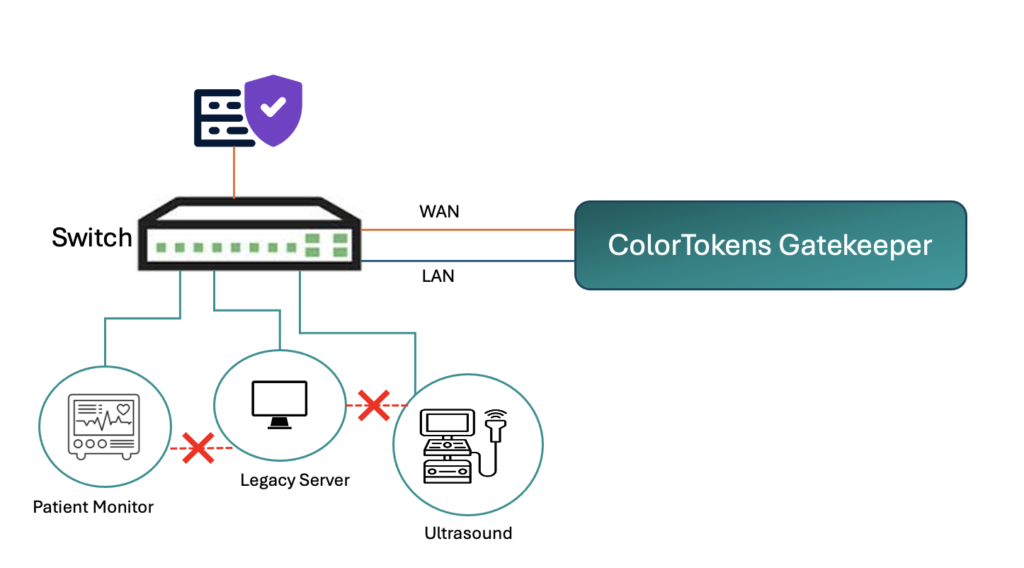
Diagram: Reference Topology of an IoMT environment with ColorTokens Gatekeeper
Conclusion
As the healthcare sector’s reliance on IoMT devices intensifies, so do the cybersecurity challenges, demanding more sophisticated solutions. Microsegmentation has become a pivotal strategy, providing granular visibility and containment to address these complexities effectively. ColorTokens Xshield™ excels in this arena by deploying advanced microsegmentation techniques that do not require agents on every device. This innovation integrates seamlessly with existing infrastructure, enforcing rigorous security policies and controlling network traffic with precision. In an era marked by increasingly sophisticated and frequent cyber threats, ColorTokens Xshield™ offers a vital edge, delivering comprehensive protection for IoMT devices and ensuring the security of patient data and operational continuity.
For robust, next-generation security solutions that adapt to your evolving needs, connect with ColorTokens and safeguard the future of healthcare technology.